This Is Where We Came In

Tuesday, September 24

We were almost on the road when I realized that I didn’t have my wallet. Was it stolen while I was distracted on a crowded bus? Did I leave it at Villa Enrichetta when we left there on Saturday? Perhaps I’ll never know. But after verifying that it isn’t actually hiding somewhere in my bags (which has happened to me before–our group calls it “pulling a Bill”), we said goodbye to Judy and Lew (who leave later today) and to Lauren and Bill (who leave tomorrow) and headed off on the road.

Fortunately, I kept no money in my wallet, so the only items to be concerned about are the credit cards, which I was able to take care of over the phone while John drove us from Genoa to Fiumicino. That’s the location of the airport: we don’t fly out until tomorrow, but we needed to return the car to EuropCar there by 2:30. We made it with time to spare. From the airport to Aran Blu Hotel in Ostia was a matter of a short taxi ride, and then we were back where we first arrived from the airport twelve days ago.

We had snacked on the way, but by this time we had skipped a meal, which is against the rules in Italy. We headed up the beach to Sotto Vente, where we shared our first meal in Italy, but André wasn’t there. Once again they had closed their kitchen early, but we enjoyed some wine and a salad and headed off in search of something more substantial. We walked further north along the beach, but found  the same situation at the restaurants there. Back at the hotel, we were advised to head to the town center, some two miles to the south. Since it was a lovely afternoon, we decided to walk there, and were rewarded by finding at Ora di Napoli, a pizzeria suggested by the hotel staff. A couple of hours later, and we were walking our pizza off on our way back to the hotel.

Noël and I did some reorganizing of the items in our bags and settled in for our last night in Italy, with the window open and hearing the surf.
Meeting Friends in Genoa

Monday, September 23

In her previous visits in Italy and the research she has done online, Judy has made several contacts, and we wanted to meet them. One was Mirella Lazzarino and the other is Jackie Janotta Rothenberg. We met both of them for a late-morning coffee in the neighborhood called the Castelletto.

Mirella is an elegant Italian lady who has lived in England and in Italy. She was recently widowed and is now living on her own. We were all captivated by her and enjoyed this chance to meet her. She walked to meet us, had coffee with us, and took a bus back to her own place nearby.

Jackie is an American writer spending a year in Genoa with her family to deeply experience another culture and to give their girls an opportunity to experience Italian schools and learn the language from interaction with other students. I highly recommend her own blog, Giorni a Genova. Italian kids go to school from 8:00 am to 1:00 pm, but that only includes a snack break, not a lunch break; Italians figure that a 1:00 dismissal time is a perfect for lunch. We met with Jackie until just before her time to pick up the kids at school.

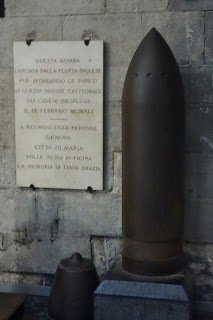
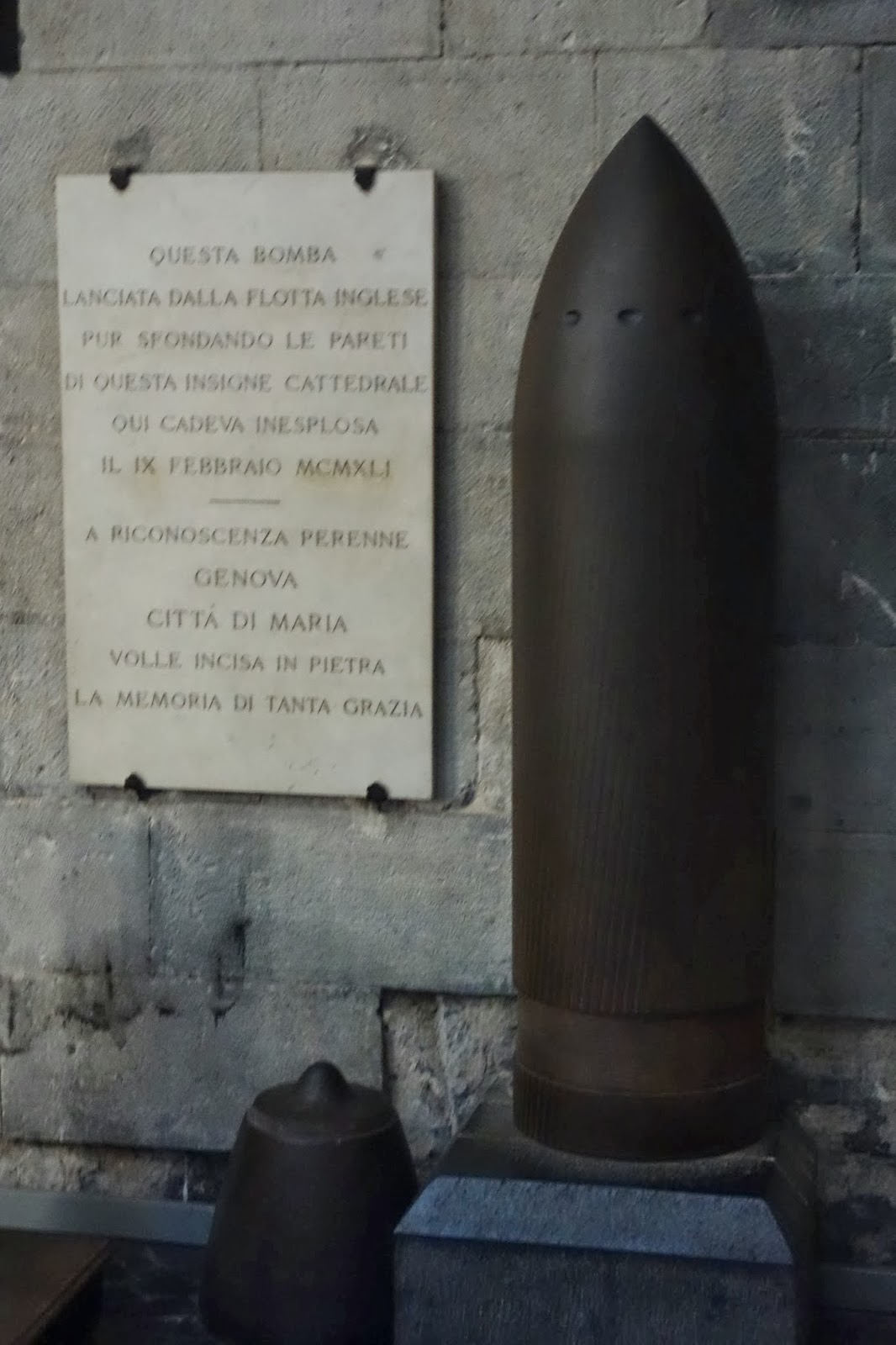
We went back down to the area around Piazza Ferrari, found another café for lunch, and visited the Cathedral of San Lorenzo, whose courtyard we had visited yesterday. This time we went inside. As you would expect of a cathedral, this is an impressive church. It’s only a few hundred meters from the Palazzo Ducali, and in the day of the Doges, this would have been the Doge’s parish church. The Cathedral offers a reminder that Italy and the USA were at war some years ago: an unexploded bomb is exhibited on the congregation’s right side, toward the back of the nave.

The inscription reads (close enough), “This bomb, launched by the British fleet, while breaking through the walls of this famous cathedral, fell here unexploded on February 9, 1941. In everlasting gratitude, Genoa, City of Mary, wishes the memory of so much grace to be engraved in stone.”

This is our last night in Genoa–tomorrow most of us will
move on. Lauren and Bill will stay one more day. For our dinner this
evening, we headed to a little shop on Via Albaro, just a couple of blocks
from the Marcelline. It’s where we had dinner last night, but tonight we
used carryout, which they call “Take Away” in Italy. The difference is
that in Italy, they generally aren’t set up for people to take food
away. If you do, you take a napkin and little else. But our shop found
plastic plates and forks, and bags to hold the focaccia, fruit, cold
cuts, and cheese that we ordered. We had a picnic on the second-floor
courtyard of the Marcelline.

After that, Judy, Lew, and
I taught Noël how to play pinochle. She did well! Then she and I Skyped
a video call to Heather and the children. By that time it was nearly
midnight, and time for us to rest up for tomorrow’s drive back to Rome.

Genova La Superba

Sunday, September 22

Comparing cities is a dangerous pastime for the occasional traveler, but making comparisons is unavoidable. Genoa doesn’t have the ancient component that Rome has: Liguria, the region that Genoa dominates, was a Roman outpost back in the ancient times. And although it has the familiar concentration of churches that we’ve come to associate with old Italian cities, it’s not the religious center that Rome is. In fact, it’s not really a center for art for art’s sake: most of the art we saw was architectural, or decoration of architecture, or recognition of important figures in the city’s history. Genoa is a port city that made its wealth by trading; so the art follows function here.
Liguria is a banana-shaped region of Italy that follows the curve of Italy’s northwestern coast. It includes Cinque Terre and Portofino on the Italian Riviera. But Genoa was once an independent republic, back before the unification of Italy, and so it has its own history as an independent nation.

When people say that Christopher Columbus was Genovese, it’s unclear what they mean. He is claimed by everyone here, it seems. The city of Genoa is happy to claim him, but so does Piacenza to the north, and Bettola has a statue of him in the town square we visited the other day. All of these places were at one time or another part of the state of Genoa, although they’re not part of the modern region called Genoa; so saying he was Genovese is pretty broad.

Someone told me once that Genoa was so hilly that it made San Francisco look like Chicago, and there’s some truth to that. High above the city is an old fort, and although it’s possible to climb it on foot, it would take some time. The streets that climb the hills in town are laid out as switchbacks, much like roads in the mountains; so to move a few hundred surface feet, you might have to walk a half mile. Genoa Transit has solved that problem by laying out several funicular railways, which sometimes run on the surface and sometimes pass through shafts cut through the hills. They are like subway cars supported horizontally on an angled wheel carriage that follows the incline of the track. We took one of those to get near an old fort, and then Judy, Kelley, and Noël stayed in that area while Lew, John, Lauren, Bill, and I walked to the castle on foot.
From there we went to the Palazzo Ducali, or Ducal Palace, which was the seat of government during the Genoan Republic. The word “Duke” is frequently used to describe the rulers of Genoa, but the actual title was “Doge,” which basically meant “leader.” The Doge was the head of a Republic, not the kind of aristocrat that the work “duke” implies. Dukes get to be dukes by having a fealty relationship with a king. The doges of Genoa weren’t subordinate to anyone except their own people. They had a nice palazzo, though, and in front of it, on Piazza Ducali, we found a market where we were able to find some interesting items for sale. Right around a corner is the Cathedral of San Lorenzo (St. Lawrence is the Patron Saint of Genoa), and the Piazza San Lorenzo had another market where we contributed even more to the local economy.

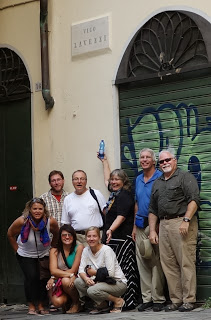
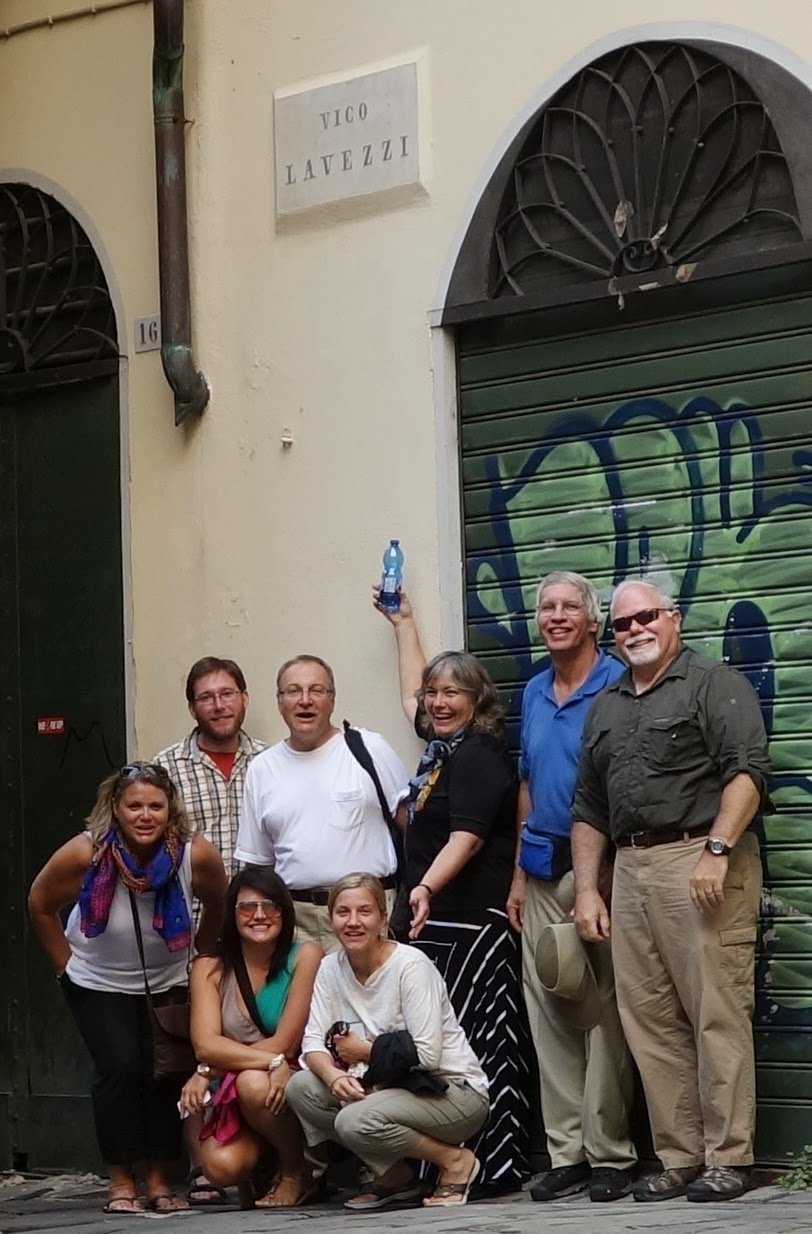
We had the opportunity also to visit our own alley: the Vico Lavezzi, which Google Maps can find but doesn’t label online. One can always hope for a Via or a Piazza, but we get a Vico, which I guess ain’t bad. Corsica used to be owned by Genoa, and there is a group of rocks there called the Lavezzi Islands. We’ve never found out whether there is any relationship between the Lavezzis of Genoa and the Lavezzis of Bettola, but we like to think there is. After all, they have an alley, and an island.

We saw a few beggars on the streets of Genoa, and some independent merchants who set up shop on the pavement; but it was generally a more relaxed atmosphere than we found at Rome, where the merchants frequently became pests. And I would say that Genoa was generally cleaner than Rome.

Before turning in for the night, Noël and I caught up by Facetime with Heather’s kids at Drake’s soccer game at home, and we decided to try again tomorrow.