That’s What I Said: Room One!

Saturday, September 21

From Bettola to Genoa is a fairly short drive, about two hours. We needed to make good time because  Kyle and Lisa needed to catch a train in Genoa to get back to Rome in time for their flight home. So we got on the road fairly early to head to Genoa, which in Italian is called “Genova.” Our residence here is La Marcelline, a multipurpose institute offering a music school, a sports institute, a pensione, and a soggiorno. A pensione is a place where retired people can stay, and a soggiorno is a place where people like us can stay while we’re in town.
The place is on rather extensive grounds, with its own gate to get on the property. La Marcelline is run by sisters, but there the similarity to Casa Santo Spirito ends. The soggiorno is more obviously set up like a hotel, with bilingual notices of various house policies, and guests get little preprinted squares of paper identifying the numbers to be used to gain 24-hour entry to the main gate and the building door. Perhaps more important, it has free Internet that actually works.
Here as in Rome, the main desk sister is once again named Gisella. Our new Gisella is a cheerful nun, perhaps a bit older than me, who speaks fairly little English. I was able to find out that Sorella (Sister) Gisella comes from a town near Lake Como, a few hours north of Genoa.
A fairly comical scene ensued as we tried to communicate just what we need in rooms and for how many nights. Most of us will leave on Tuesdayt; but Kelley will leave on Monday, and Lauren and Bill will stay until Wednesday. Our plan is for Noël and Kelley to stay in one room for the next two nights while I stay in a single (the same arrangement we used in Bettola); then on Monday, after Kelley checks out, I’ll vacate my room and move in with Noël.
It would have been hard enough simply to communicate not only which rooms we needed for which nights, but we thought (incorrectly, as it turned out) that they wanted to know would  be staying in each. My use of the Italian phrase book had its limits! We were dealing with Italian numbers and dates, and to make things more complicated one of our rooms is actually Room One (Camera Uno), so we had a hard time distinguishing between “one room” and “Room One.” Judy speaks Spanish, and her “Spitalian” has come in very handy. But if you try to imagine the Abbott and Costello “Who’s on First” routine, only with hotel rooms instead of baseball positions as its topic, carried on in three languages, with three or four participants, then you have a fair idea of the scene. Fortunately, one of the pensioners, Seniora Mirella, an Irish widow who has lived in Italy for several years, came to the rescue by providing translations between us and Sister Gisella.
La Marcelline is a block or two from the Ligurian Sea. After Kyle and Lisa had been delivered to the train station, several of the others went for a walk to the sea; but Lew and I had another mission.

The sisters didn’t think we’d be able to find a laundry nearby; but Lew had found one online, so off we were. When we arrived at the lavanderia automatico, several young men were there watching a movie on a computer, but none of the machines was in operation. None of the young men spoke English, and my phrase book doesn’t have a word for “detergent”; it soon became clear that they had no idea what was what at the laundromat: they weren’t using the WiFi while waiting for their clothes; the laundromat was a WiFi hotspot, and that was their reason for being there. We chose our detergent as best we could from the half-dozen choices offered in the vending machine; fortunately, what appeared to be the cool-water detergent turned out to be a good bet. We had to do some trial-and-error to figure out how the pricing worked on the machines, but in the end we were rewarded with truly clean clothes for the first time in a week or more.

Once we got back to La Marcelline, it was time for us to head out for dinner at a restaurant that the others had scouted on their walk by the waterfront. I had heard that one should walk carefully on the streets of Genoa. The Italians take their dogs everywhere, and some are less good than others at cleaning up. We had our advance walkers sound off “Code Brown” or simply marrone, the Italian word for brown, as a warning to those following. We were able to avoid the marroni both on our way to the restaurant (in twilight) and on our way back (in the dark). And by the time we were done with dinner and the obligatory gelato stop, it was time for us to head to our rooms.

Not for all of us, however. Noël and some of the others have been playing a game called Pictureka on Noël’s iPad, and that will go on for a while yet. For me, though, it’s time to make use of the free Internet here.

Curds, Whey, and the Family Town

Friday, September 20

Bettola is about an hour’s drive away from the region that produces what many consider the king of cheeses: Parmigiano-Reggiano. As the name suggests, Parmigiano-Reggiano is produced in two towns, Parma and Reggio Emila, and the area around them. We headed to Parma this morning to tour Consorzio Produttori Latte, one of the many caseificias that convert milk into Parmigiano-Reggiano cheese.

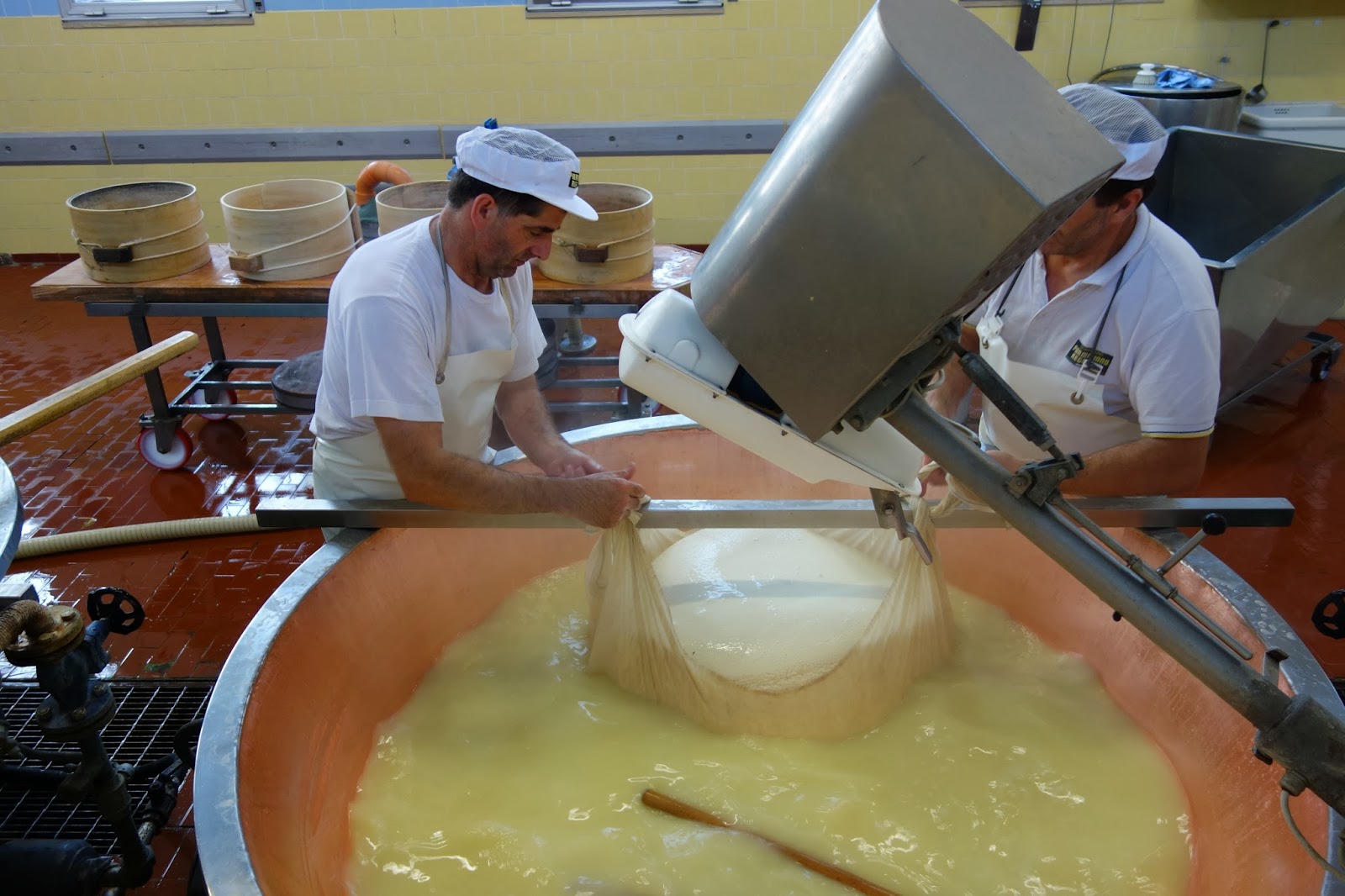
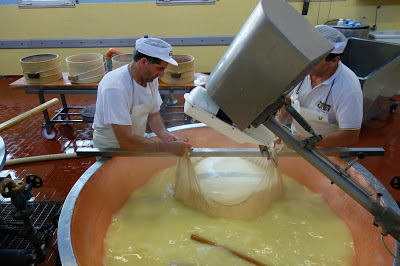
The process is pretty interesting to watch. Milk is cooked in a cone-shaped cauldron about three feet high. When the curds separate from the whey, they sink to the bottom. One of the cheesemakers uses a tool shaped like a canoe paddle to pull the curds away from the sides of the caldron. Meanwhile, his partner slips two corners of a cheesecloth underneath the ball of curds, and then the two of them pull the ball up from the bottom of the caldron and hang it from a metal rod spanning the top of the caldron.

This is a pretty big chunk of cheese: the final cheese will weigh about 70 pounds, so I’m guessing that with all the liquid in there the curds must weigh pretty close to 100 pounds.

The curds are placed in a form (hence the Italian word for cheese, formaggio), which presses a plastic ring into the side of the cheese to imprint the date, batch, serial number, etc. From there the cheeses go to a brine bath for a month. The brine bath leaches out the lactose in the cheese; I was surprised to learn that Parmigiano-Reggiano is lactose-free. Not surprisingly, the brine bath also adds salt to the cheese and toughens the rind: I had always assumed that Parmigiano-Reggiano had a wax or cloth skin, but the rind we see is simply a part of the cheese, and although it’s edible, it’s tough enough to protect the cheese.

“Parmigiano” is simply the Italian adjective for Parma; we, of course, say “Parmesan.” Evidently the cheese has been famous for a long time: I remember the British diarist Samuel Pepys detailing his efforts to save his “Parmazan” cheese from the Great London Fire of 1666 by burying it in his yard before evacuating. Christiana Capelli, our guide, made sure that we understood that not all “Parmesan” cheese is Parmigiano-Reggiano, and of course that message is one of the reasons why they make these tours available. We enjoyed the samples they offered before we left, and visited their store to purchase some gifts and mementos. After our immersion a few days earlier in the life of ancient Rome and the treasures of the Vatican, it made a fascinating look at an everyday product of our own times.

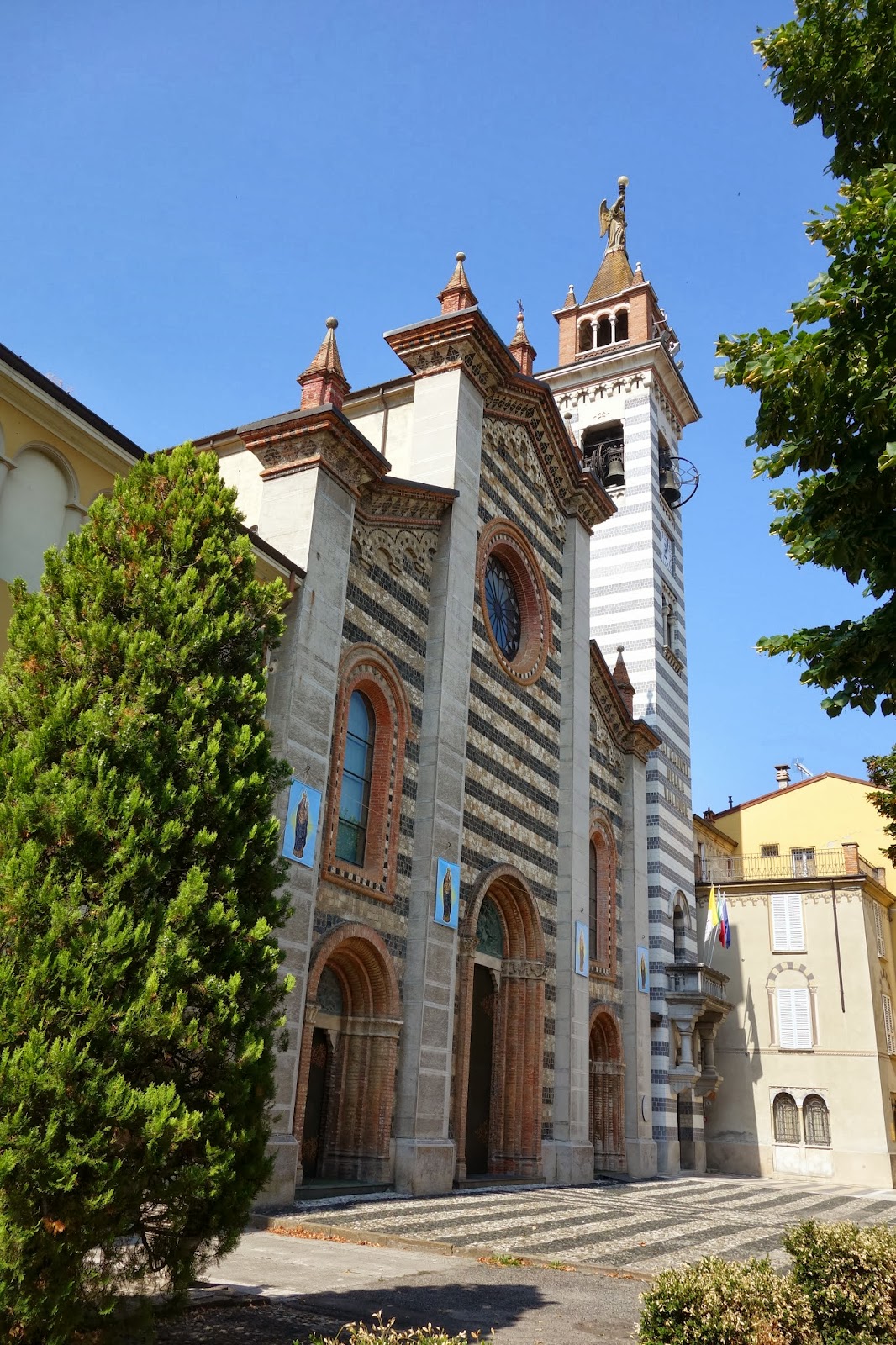
With a stop for coffee on the way back, we spent the rest of the day in Bettola. We arrived pretty close to siesta time, which gave us an opportunity to look over the lovely town square. A statue of Cristoforo Colombo occupies one end of the town square, and a fountain occupies the middle. One side has a café, the municipio (town hall), and a tabacchi (the ubiquitous “tobacco” shop, carrying everything from prepaid cellular minutes to candy to post cards to actual tobacco). On the opposite side and dominating the square is the parish church.
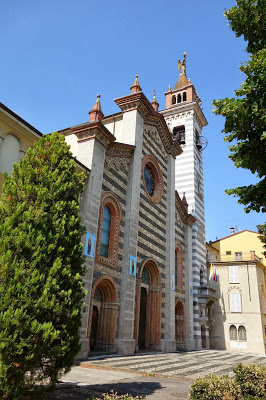
The church is referred to as the Sanctuario di Santa Maria della Quercia: the Sanctuary of St. Mary of the Oak. The name refers to a 1496 apparition of the Blessed Virgin to shepherds at an oak tree near Bettola. If I understand the Italian correctly, the present church dates to 1954, but the list of pastors on the wall goes back to 1828, including the pastor who would have baptized my great-great-grandfather. The campanile (bell tower–seems like all the churches here have one) bears large letters reading Ai caduti della Valnure–“To the fallen of Valnure.” Valnure, the Nure Valley, is the name of the geographical area that includes Bettola. We sometimes forget that 70 years ago, we were at war; we would occasionally see reminders like this.

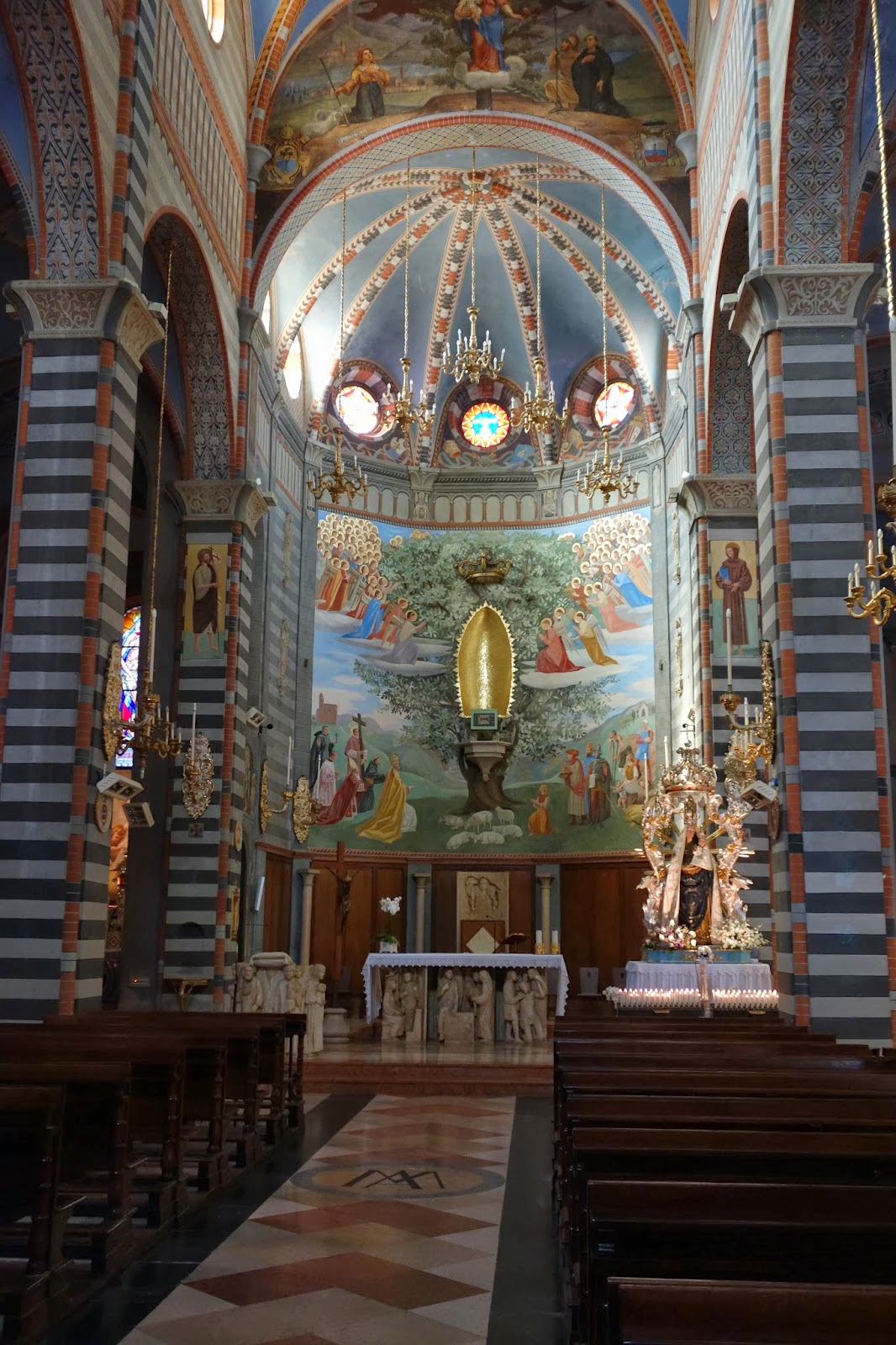
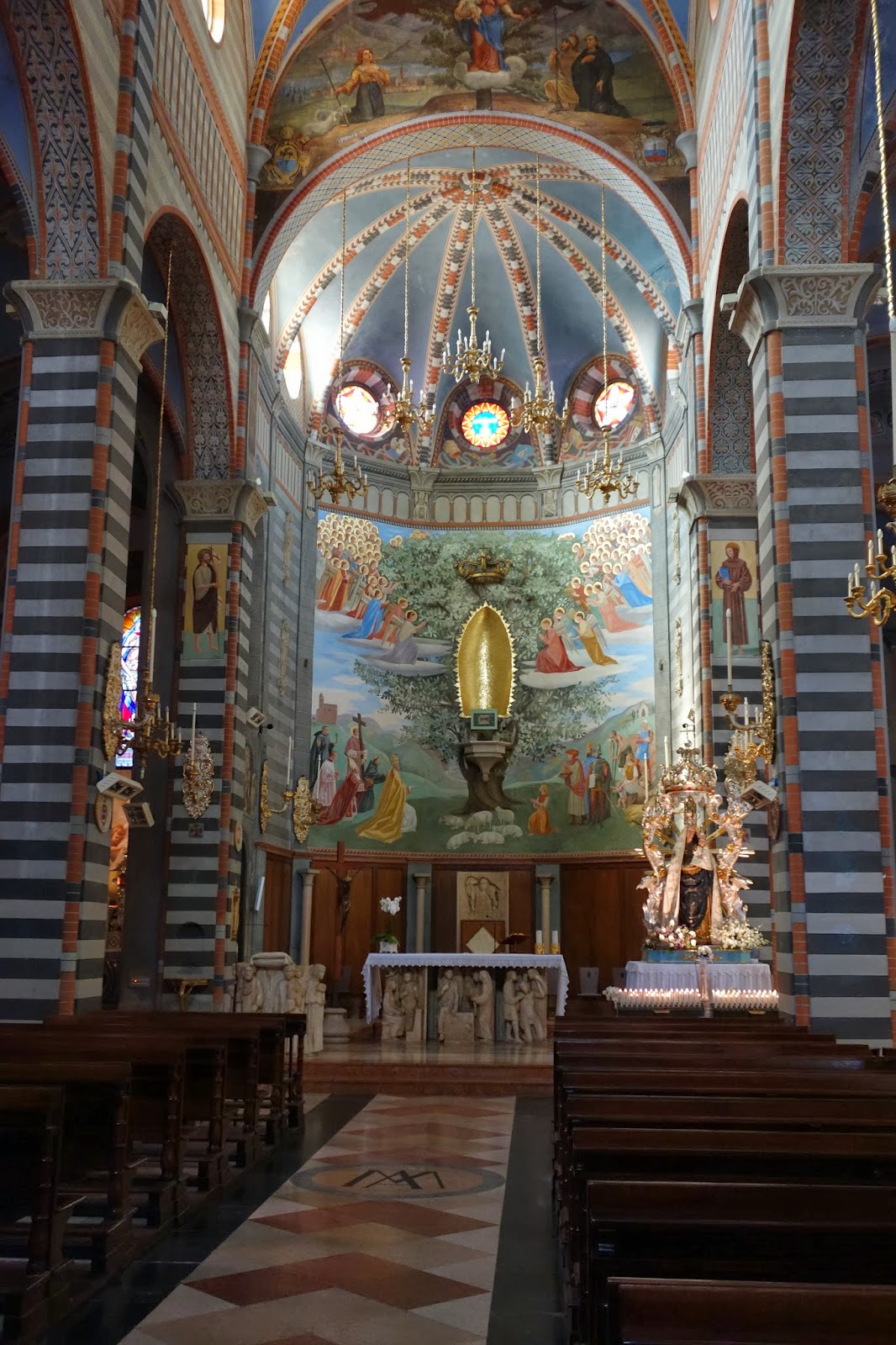
Evidently, this a church still has a congregation; signs of current worship are everywhere, although I didn’t see an organ or any other instrument. The sanctuary has a golden niche to hold a statue of the Blessed Virgin, when she isn’t out in the church closer to the parishioners, as she was for our visit. You can see her on the right side in the photo below.

We went for lunch at Ristorante Agnello, a few doors down from the church, joined by Francesco and his mother, Maria Luisa. We think that they are related through the Costas, one of the many branches of our family formed through the dozens of marriages over the years. As we sat in the outdoor café area, Bianca Lavezzi, a Bettola expatriate who spends most of her year in England and part of the year at her apartment across the square from where we were sitting. We chatted with Bianca for just a few moments–she was on her way to a meeting with her attorney, who has an office near the restaurant.

We had visited Francesco’s Vecchia Stazione the night before, and we stopped there briefly to meet his father. At their recommendation, we headed off to Grazzano Visconti, a reconstructed medieval fortress about halfway between Bettola and Piacenza. According to Wikipedia, it dates to 1395 and was somewhat restored in the early 20th century. Today it is perhaps most notable for its shops, but it was fun to walk around the grounds and see some of the exhibits.

We stopped at the Vecchia Stazione one more time for some snacks and drinks, and then it was time to head back to Villa Enrichetta for the usual late dinner. We had Francesco call ahead and explain to GiamPier that we would need a lighter dinner than usual. That proved to be a good move: we made do with only a single pasta dish and the usual salume (plate of cold cuts) this evening, and we left the table a bit less overloaded than on some of the previous evenings.

Tomorrow we plan to settle our accounts, take a few more pictures on the town square, and then head to Genoa.
On to Bettola

Thursday, September 19

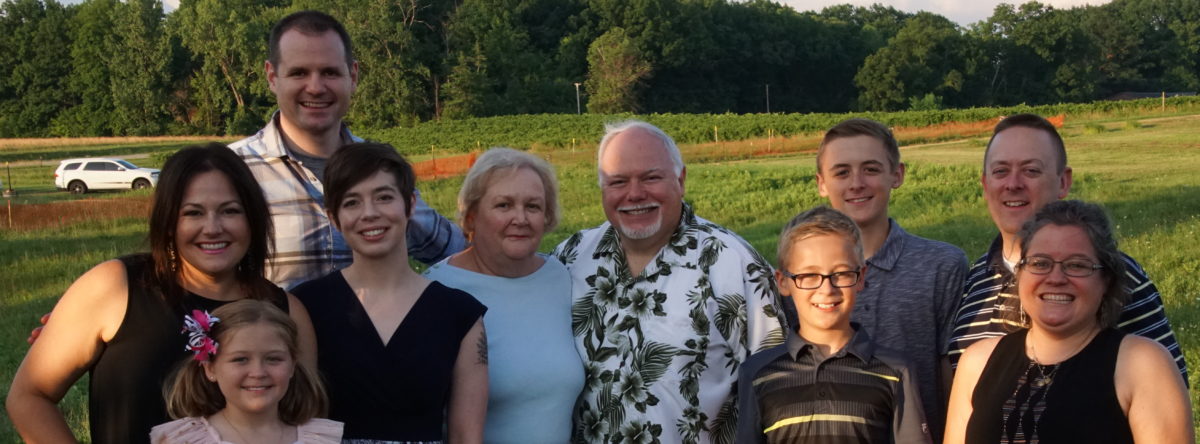
We had breakfast at La Novellina with Anna and Bart, friends of Judy’s. Anna was Judy’s Italian contact who set up our accommodations in Cicagna. Our party was too big for La Novellina, so John and Elaine’s daughters and their men stayed these two nights at another place nearby. Once we had regrouped, we began the ride north to Bettola.
This, by the way, is the single scariest ride of my life. For part of our way, our road ran right through a nature preserve on the side of a mountain, which meant one-lane dirt switchback roads without guard rails. Our drivers handled this amazingly well, and within a couple of hours we had crossed over the mountains and arrived at Bettola, the town where the Lavezzis moved from Soglio in the mid-1800s and from which they emigrated around 1870.
Our accommodations here were at the Villa Enrichetta, which in the USA would be called a dude ranch. Noël says the accommodations reminded her of band camp; and although my own camping recollections are more primitive, it is certainly rustic enough. 
Bettola today has about 3,000 inhabitants, and to my eyes appears to be essentially a bedroom community for the town of Piacenza, about a half hour to the north. It has a very pretty town square and another beautiful church, and a remarkable bar called Vecchia Stazione (the Old Station), tended by a 33-year-old bundle of energy named Francesco Costa. Francesco is an old acquaintance of Judy’s, and has done some research work for her. Although he says his English is poor, he speaks it pretty well–certainly far better than any of us speak Italian. Francesco had us all in for drinks and snacks, and then we settled in at the Villa for dinner before what would be an early morning tomorrow.
Tomorrow, we meet the Big Cheese–about 100 pounds of Parmigiana Reggiano. We’re going on a cheese tour.